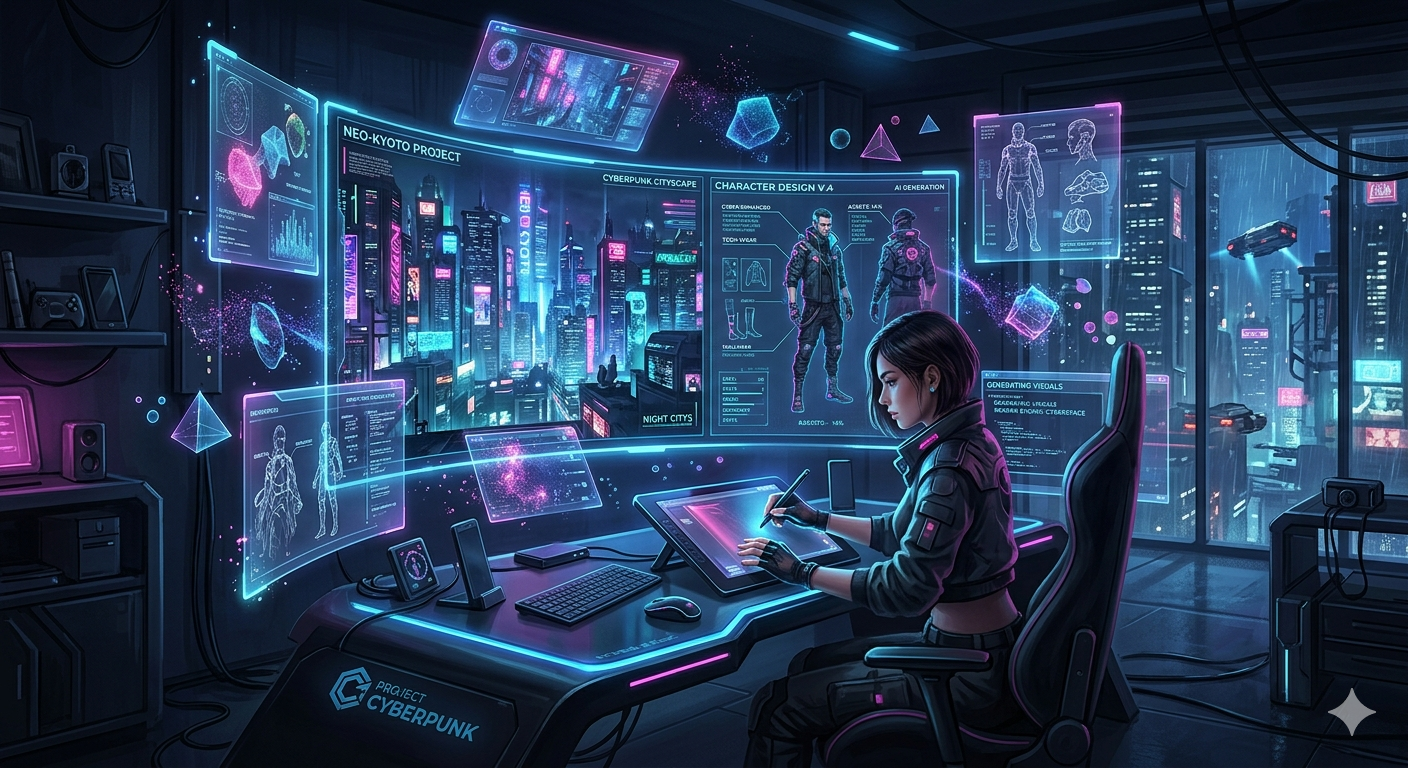
Look, I’m going to be honest with you. I’ve spent the last six months wrestling with AI art tools to create concept art for a cyberpunk TTRPG I’m building. The frustration was real.
MidJourney gives you gorgeous results, but it’s like pulling teeth to get a consistent character. Stable Diffusion is powerful, but you need a PhD in prompt engineering to get something that doesn’t look like a melted candle. Then I stumbled onto Nano-Banana, and honestly? It changed my workflow.
This isn’t some generic hype piece. I’ve actually been running this thing on a secondary rig to generate backgrounds for Fiverr clients while I sleep. Let me show you exactly how I use it to crank out futuristic cityscapes and character concepts without losing my mind.
Why Nano-Banana Doesn’t Suck (Mostly)
The tool is basically a streamlined interface for Stable Diffusion, but they’ve done something right with the “Nano” part—it’s optimized to run on lower-end GPUs. I’m running it on an old RTX 2060, and I can still generate a batch of four images in under two minutes.
The “Banana” part of the name is just marketing fluff, but the interface is clean. No 500 sliders. Just the stuff you actually need.
The Good Stuff
- Speed: It’s genuinely fast. I set up a bot to generate “abandoned space ports” every hour and dump them into a folder. By morning, I had 20 usable assets.
- Consistency: They have a “style lock” feature that actually works. This is huge if you’re doing a series.
- Price: The free tier gives you enough credits to actually test it. Unlike some platforms that give you 5 generations and then laugh at you.
The Annoying Stuff
- Upscaling: The built-in upscaler is mediocre. I always export and run the final through Topaz or a separate ESRGAN model.
- Community Models: They have a library, but it’s smaller than Civitai. You’ll often have to upload your own
.safetensorsfiles.
Nano-Banana vs. The Big Boys
I tested this against my usual setup so you don’t have to. Here’s the raw data:
| Feature | Nano-Banana | MidJourney | Automatic1111 |
|---|---|---|---|
| Ease of Use | Easy (Drag & Drop) | Medium (Discord only) | Hard (Configuration Hell) |
| Hardware Requirement | Low (Runs on 4GB VRAM) | Cloud-Based (No GPU needed) | High (Needs local GPU) |
| Control (LoRA, Inpainting) | Medium | Low | High |
| Cost | Freemium / Cheap | Subscription ($10+) | Free (if you own the PC) |
| Consistency | High (Style Lock) | Medium (Varies by seed) | High (If you know what you’re doing) |
Verdict: Nano-Banana sits right in the sweet spot. It’s easier than Automatic1111, but gives you way more control than MidJourney.
Beginner’s Guide: Your First “Neon Samurai” in 10 Minutes
Alright, let’s get our hands dirty. Here’s the exact workflow I use when I’m too tired to mess with complex nodes.
Step 1: Get the Model Don’t use the default one. It’s generic. Go to the “Models” tab in Nano-Banana and search for “DreamShaper” or “RevAnimated”. Download it. These are photorealistic but with an artistic tilt—perfect for concept art.
Step 2: The Prompt (Copy-Paste This) I’ve refined this prompt over 200 generations. It gives you that gritty, futuristic look without the “AI slop” texture.
cinematic shot of a cyberpunk samurai, neon-lit alleyway, rain-slicked streets, holographic advertisements, intricate armor plating, detailed face, moody lighting, 8k, unreal engine 5, artstation, high detail, sharp focus
Step 3: The Secret Sauce (Negative Prompt) This is what keeps it from looking like a cartoon.
ugly, tiling, poorly drawn hands, deformed, disfigured, blurry, bad anatomy, watermark, signature
Step 4: The Nano-Banana Tweak Look for the slider that says “Guidance Scale” or “CFG”. Set it to 7.5. Lower gives the AI too much freedom, higher makes the image look burnt. Set the steps to 30. Anything over 30 is a waste of electricity.
Hit generate. If it comes out looking like a potato, check your VRAM usage in the settings. You might need to lower the resolution to 512x768 first, then upscale later.
Making This Actually Useful (Real Scenarios)
I don’t just make art for my wall. Here’s how I’m using this in the real world:
- Fiverr Automation: I created a specific style for “Futuristic Portraits”. I run a batch of 50 prompts overnight, pick the best 10 in the morning, and list them as custom orders. Clients love the turnaround time.
- TTRPG Assets: My group is running a Shadowrun campaign. I generate specific NPCs on the fly. “Dwarf Decker with a grudge?” Bam. 30 seconds. Slap it on a token, and we’re rolling dice.
- YouTube Thumbnails: The “Style Lock” feature is gold here. I generated a consistent “robot uprising” look for a whole series of thumbnails. Keeps the channel looking professional.
Which Nano-Banana Should You Use?
The tool has two main “modes” or rather, two ways to interact with the base engine.
Option A: The “Turbo” Mode (For Beginners)
This is the default. It’s fast, it’s optimized, and it uses a distilled version of the model. The images are 80% as good as the full model, but they load in 10 seconds.
- Pros: Instant gratification, great for brainstorming, uses fewer credits.
- Cons: Less detail, can look a bit “soft” if you pixel peep.
- Best For: Getting ideas down, generating social media posts, or if you have an older GPU.
Option B: The “Quality” Mode (For Advanced Users)
You have to toggle this on in the settings. It uses the full precision model. It takes 3-4 times longer, but the texture details are insane.
- Pros: Commercial quality output, handles complex lighting (like neon fog) perfectly.
- Cons: Eats VRAM for breakfast. My 2060 cries a little every time.
- Best For: Print work, high-res art prints, or client work where they pay for detail.
My Honest Recommendation
If you’re a beginner: Just stick to Turbo Mode. Don’t overcomplicate it. Use the prompts I gave you, tweak the colors, and learn how the “Style Lock” works. You’ll have usable art in 5 minutes. Trying to run Quality mode on a laptop will just lead to frustration and crashes.
If you’re an advanced user: Go straight for Quality Mode and start importing your own LoRAs from Civitai. Nano-Banana handles custom weights surprisingly well. I’m currently using it to train a specific LoRA on my own sketches, then using the tool to render them out fully. It’s cut my production time for client concepts from 3 hours to about 45 minutes.
Honestly, just go fire it up. The hardest part is deciding what to make first.